
How to Prepare Your Dam for a Healthy Litter (From Conception to Whelping)
A healthy litter starts with a healthy dam. The roughly nine weeks between breeding and whelping shape the size, strength and vitality of every pup, and how well your female comes through it. Good breeders plan this stretch as carefully as they plan the pairing itself. Here is how to care for your dam from conception to whelping day.
1. Start with a Pre-Breeding Vet Visit
Before she is ever bred, take your female for a full checkup. Make sure her vaccinations and deworming are current, her weight is ideal and her health clearances are complete. A dam that goes into pregnancy lean, fit and parasite-free has a big head start. Ask your vet about a brucellosis test for both dogs, too.
2. Confirm the Pregnancy and Know Your Dates
Pregnancy in dogs lasts about 63 days from ovulation, which is one more reason to use progesterone testing to time the breeding. Your vet can confirm pregnancy by ultrasound at around 25 to 30 days. An X-ray in the last week or so lets you count the puppies, so you will know when she is finished whelping. Mark the expected due date on your calendar and plan to be home that week.
3. Feed for the Last Third of Pregnancy
For the first five weeks, keep her on her regular high-quality diet and don’t overfeed; extra weight early can make whelping harder. Puppies do most of their growing in the final three weeks, so that is when her needs climb. Gradually transition her to a high-quality puppy or performance formula and increase her food a little at a time, splitting it into smaller meals as her belly fills. Ask your vet before adding supplements; extra calcium during pregnancy can actually raise the risk of eclampsia after whelping.
4. Keep Her Fit with Safe Exercise
A fit dam has an easier delivery. Keep up daily walks and light free-running through most of the pregnancy, but drop hard roading, heavy hunting, jumping and rough play, especially in the last few weeks. Keep her away from strange dogs and crowded places to protect her from illness.
5. Set Up the Whelping Box Early
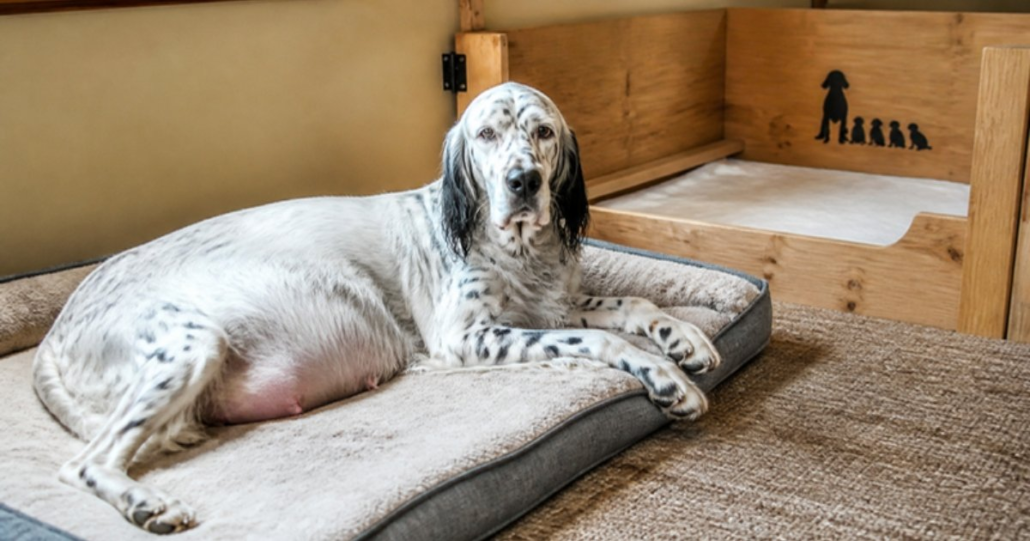
Have the whelping box ready at least two weeks before the due date, so she can get comfortable sleeping in it. Choose a quiet, warm, draft-free room. A good box has sides high enough to keep puppies in, a low entry for the dam and “pig rails” around the inside so she can’t accidentally pin a puppy against the wall. Newborns can’t regulate their temperature, so plan on a safe heat source to keep part of the box warm, with a cooler side she can move to.
Put together a whelping kit: clean towels, a digital thermometer, a bulb syringe, dental floss and clean scissors for cords, a scale, a notebook to record birth weights and times, and your vet’s after-hours number.
6. Watch for Signs of Labor
Start taking her rectal temperature twice a day about a week before her due date. A normal temperature is around 101 to 102.5°F; a drop below about 99°F usually means labor will start within 24 hours. You may see nesting, restlessness, panting and a loss of appetite. Call your vet if she has strong contractions for 30 to 60 minutes without producing a pup, goes more than two to four hours between puppies, or has a dark green discharge before the first pup is born.
Careful preparation pays off in strong, healthy puppies and a dam who recovers quickly. Once the pups are on the ground, the next step is socializing your litter before they go home.
Expecting a litter?
Post your upcoming litter now so serious hunters can reserve a pup before they’re even born.








Leave a Reply
Want to join the discussion?Feel free to contribute!