How to Train a Flushing Dog: Quartering, Retrieving and Bird Work
Few things beat watching a young spaniel or Lab come into its own as a bird finder. Here’s how to train a flushing dog from the ground up, covering the gear you need, the role of positive reinforcement, and a month-by-month approach to teaching your dog to quarter, flush and retrieve.

What makes a good flushing dog
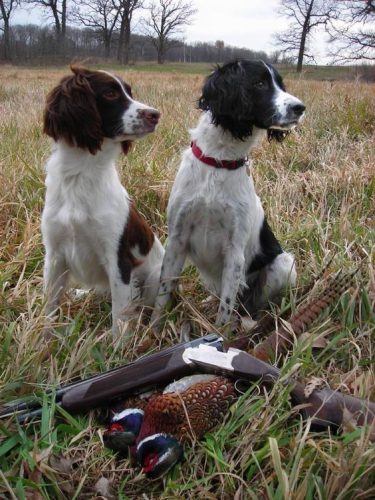
A flusher needs a strong nose to find and trail scent, and the courage to drive into any cover where a bird might hide, from cattails to blackberry brambles. It also needs to stay close enough that birds flush within gun range. Learn more about the breeds in our guide to the best flushing dog breeds.
What you need to get started
- Good breeding: a pup from parents that actually hunt. Look for flushing dog breeders in our listings.
- A pup that wants to learn, and your patience
- A check cord (20–30 ft)
- A training whistle, such as the Roy Gonia Special whistle
- Training dummies: see our bumpers and training dummies
- Pigeons or chukar, and eventually a blank pistol
Use positive reinforcement
Praise is your most powerful training tool. Correct obvious mistakes, but make sure “Good boy” or “Good girl” comes quickly and warmly whenever the dog gets it right: when it obeys a command, checks out the cover you point to, or finds and flushes a bird. Save your stern voice for when you need it, and only correct a dog in the moment; late corrections just confuse it.
How to teach a flushing dog to quarter
Quartering, working back and forth in front of you within gun range, is the most important skill a flusher learns.
- Build independence (month 1). Take your pup on walks in short grass or half-grown hay where it learns to range out and follow you. Gradually move into thicker cover.
- Introduce the check cord. Let the pup drag it on a few walks so it gets used to it.
- Walk a zigzag (next month, 2–3 times a week, 15 minutes). Walk about 30 paces at an angle to the right, then turn and walk 30 paces to the left. At each turn, call the dog’s name, give a sweeping arm signal in the new direction, and use the same whistle signal every time. A light tug on the cord helps it understand.
- Take off the cord. After a few weeks, let the dog run free and keep turning it with your voice, whistle and arm signals as you zigzag. A remote trainer on a very low setting can help get its attention once it understands the turn.
- Add birds. Plant pigeons or chukar along your zigzag route so turning pays off. Don’t dizzy birds so much that the dog can catch them.
- Add the gun gradually, only after the dog is conditioned to gunfire, starting with a blank pistol at a distance.
- Work retrieves into every session. Three or four fun retrieves per walk keeps the dog eager.
- Move to real cover. Plant birds in islands of thick cover, and teach the dog to work back and forth between two cover edges. Hunting with a friend? Have the dog work between the two of you.
- Finish at a preserve. Ask the preserve to plant birds in a diagonal pattern, marked with a ribbon so you know where they are. Always work the dog into the wind.
Recommended training collars for flushing dogs
- Close-range trainers for upland and water: SportDOG FieldTrainer 425X, SportDOG WetlandHunter 425X, SportDOG SportTrainer 575
- Longer-range options for big fields: SportDOG SportHunter 825X or H2O 1850 PLUS Remote Trainer
- Compare all remote training collars and extra collars
New to e-collars? Read our e-collar training guide for hunting dogs first.
Find a well-bred flushing dog
Search springer, cocker, Boykin and Lab puppies and started dogs, or advertise your own.
Have fun in the field. Training a flushing dog should be a blast, not a chore.





Leave a Reply
Want to join the discussion?Feel free to contribute!